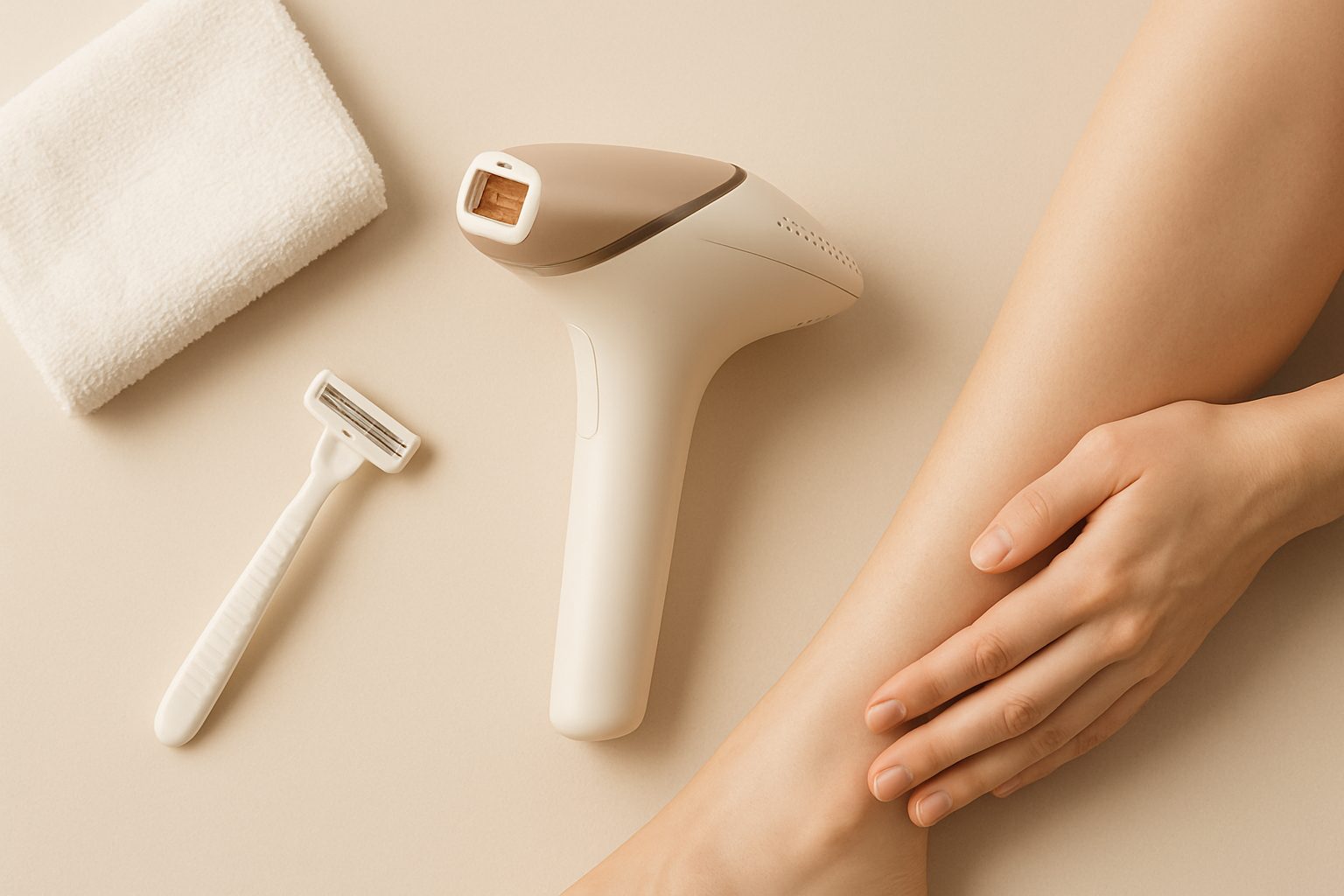
How Does IPL Hair Removal Work at Home? A Plain-English UK Guide
If you've been scrolling through home hair removal devices, you'll have noticed IPL (Intense Pulsed Light) keeps cropping up. The marketing promises sound brilliant — permanent-looking results without razors or waxing strips. But how does it actually work? And does it work as well as the ads suggest? Let's cut through that and explain what's genuinely happening on your skin.
The Basic Principle: Light Targeting Dark Pigment
IPL devices emit broad-spectrum light pulses that penetrate your skin. The crucial bit is that this light gets absorbed by melanin — the dark pigment in hair. When the light hits the melanin, it converts to heat. That heat damages the hair follicle underneath your skin, which eventually stops producing new hairs.
This is why the technology works differently depending on your hair and skin colour. Dark hair absorbs light efficiently, so the follicle heats up quickly and effectively. Fair or red hair? It absorbs far less light, so you get weaker results or need more treatments. Blonde hair barely works at all. And if your skin is very dark, some of that light gets absorbed by your skin tone rather than the hair, which can reduce effectiveness and increase the risk of irritation.
That's not a flaw in the device — it's physics. No home IPL system gets around this limitation, no matter what the marketing says.
Why Multiple Sessions Are Non-Negotiable
Here's where most people get frustrated: one IPL session doesn't eliminate hair permanently. You'll need somewhere between 8 and 12 treatments, typically spaced 2 weeks apart, sometimes longer between later sessions.
The reason comes down to your hair growth cycle. At any given moment, your hairs are in different growth phases. Only hairs in the active growth phase (anagen) have enough melanin in the follicle for IPL to work effectively. Hairs in the resting or shedding phases have already broken from the follicle, so the light has nothing to heat.
This means each IPL session only damages the hairs that happen to be in the right growth stage — roughly 20 to 30 per cent of your total hair. By repeating treatments every two weeks over several months, you catch most hairs during their active phase. You'll notice hair falling out after each session (usually within 1 to 2 weeks), and regrowth gets thinner and slower with each round.
The Permanent vs. Permanent-Looking Distinction
Advertising often uses the word "permanent" loosely. Technically, IPL doesn't destroy every single follicle permanently. What it does is damage follicles enough that they stop producing normal, thick hairs. Some dormant follicles may reactivate in years to come — which is why some people need the occasional touch-up treatment every few months or once a year. Think of it as a very long-lasting reduction rather than true permanent removal.
Realistically, after a full course of treatments, most people experience significant and lasting hair reduction. The hair that does grow back is usually finer, lighter, and slower than before. That's a meaningful quality-of-life change for most people.
What Affects Your Results
Beyond hair and skin colour, a few other factors matter:
Hair thickness. Coarse, dark hairs respond better than fine, pale ones. If you have naturally light body hair, IPL might be disappointing.
Hormones. If your hair growth is driven by hormonal conditions (PCOS, for example), IPL won't address the underlying cause. You may see reduction, but new hairs will keep growing from dormant follicles stimulated by hormones.
Sun exposure. A fresh tan (or any recent sun exposure that's darkened your skin) makes IPL less safe and less effective. You need to avoid sun exposure for about two weeks before and after treatments.
Device power. Home devices are less powerful than professional IPL systems. They're safer because of this, but it also means results take longer and are typically less dramatic than salon treatments. It's a trade-off between convenience and potency.
What to Actually Expect
In the first 1 to 2 weeks after your first session, treated hairs shed. You might feel like nothing is working because new hairs haven't stopped growing yet. Stick with it.
After 3 to 4 sessions (spanning 6 to 8 weeks), regrowth becomes noticeably slower and finer. This is usually when people feel the device is worth the time.
After 8 to 12 sessions, you've caught most hairs in their active phase multiple times. Regrowth is substantially reduced. Some people achieve near-total clearance; others plateau at 80-90 per cent reduction, particularly on lighter hairs.
Maintenance varies. Some people don't need another treatment for 6 to 12 months. Others prefer a touch-up session every few months to keep results consistent. Your hormones, genetics, and individual hair growth will determine this.
The Honest Reality
Home IPL works — genuinely. Thousands of people see real, lasting results. But it's not instantaneous, it works better on certain hair types, and it requires patience and consistency. If you're expecting to zap your legs once and never shave again, you'll be disappointed. If you're willing to commit to a course of 8 to 12 treatments over 3 to 4 months for significantly reduced, slower, finer regrowth, you've got a realistic picture of what to expect.
Ready to explore which devices actually deliver? Have a look at our roundup of the best home IPL systems for UK skin and hair types.
More options
- Philips Lumea IPL Hair Removal Series (Amazon UK)
- Braun Silk Expert Pro 5 IPL (Amazon UK)
- Ulike Sapphire Air3 IPL Device (Amazon UK)
- SmoothSkin Pure Fit IPL (Amazon UK)
- Remington iLight IPL Hair Removal (Amazon UK)